
On-demand webinar
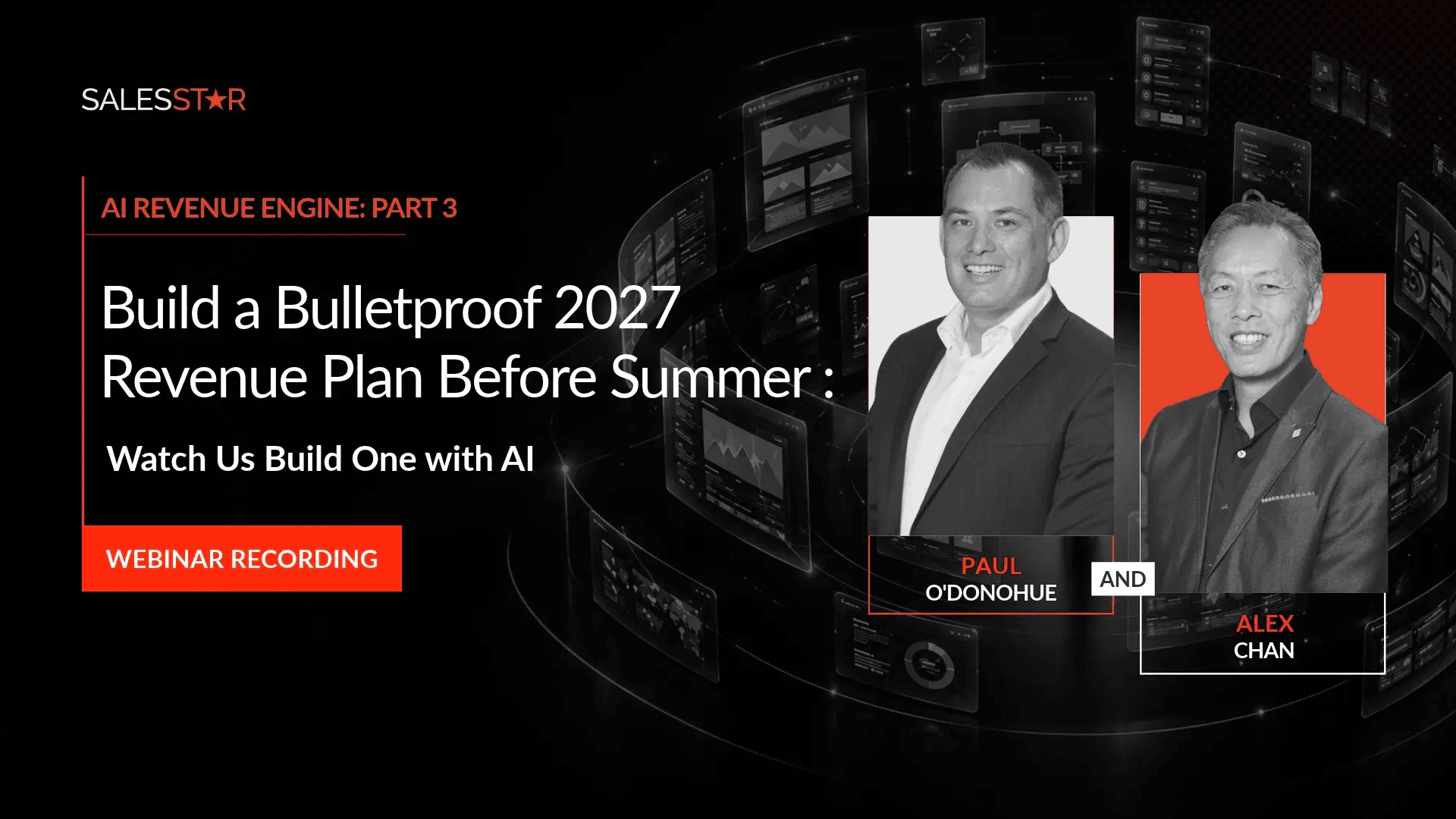
Build a Bulletproof 2027 Revenue Plan Before Summer
What you’ll learn :
- Why a 2027 plan needs a framework, not last year's growth rate plus 10 or 15%, and why strategy means saying no more often than yes
- How the one-page sales plan puts your financials, growth intent, leading activity, ideal client, the problems you solve and your messaging on one page
- How AI sizes an addressable market, pulls out a target customer's pain points, and works a $3,000,000 growth goal backwards into deals and meetings per week, shown live on a real client
- Why the plan only works if your team builds it with you, with AI as the helper and not the replacement
Speaker :
Paul O'Donohue
Founder CEO · Global
Alex Chan
Chief Growth Advisor, SalesStar
What's covered
Inside the session. What it covers, then get the full recording.
Alex Chan, Chief Growth Advisor, introduces Paul O'Donohue, founder and CEO of SalesStar. They place the session as Part 3 of the AI Revenue Engine series, after sales process (Part 1) and practising with AI (Part 2), and promise to build a plan live.
Paul's answer: frameworks, and focus. Guesswork becomes hard work, AI answers vary unless they are tied to a framework, and the fussier you are about your ideal client profile and value proposition, the faster you grow. Plus why a team that helps build the plan does not fight it.
The audience poll: 17% said data driven with the team bought in, and 72% said they have targets but no real strategy behind them. Paul warns that adding 10 or 15% to last year is a number, not a strategy.
The framework behind everything that follows: financials, strategic growth intent, market position, leading activity, target market and ideal client profile, the problems you solve, and strategic messaging. Paul explains why early plans ran to about 57 pages and went into a drawer.
A client who volunteered, a New Zealand business that designs, manufactures and installs on-site wastewater systems, is taken through Ask Penny. It proposes ideal client profiles, estimates the size of the addressable market in moments, and lists the pain points of the target segment, starting with compliance.
With a $100,000 average sale and about 50% proposal-to-close, a $3,000,000 goal means 30 deals, or roughly three discovery meetings a week. The hours are broken down by activity, and Paul and Alex discuss where AI can take on administration so the plan does not need extra payroll.
After audience questions, including how secure Ask Penny is, Paul asks it for a complete plan with strategic messaging and playbooks: ideal client, referral channels, problems solved, outbound messaging, how to ask for a referral, objections and consultative questions. The client says doing this by hand would take days.
What was offered to attendees at the end: a Revenue Readiness Scorecard, 30 minutes with a growth adviser, 30 days of Ask Penny and community access, for decision makers. Then the SCALE Boardroom for CEOs, founders and their sales leaders, and live questions.
Resources
Get the recording
Frequently asked questions
Common Questions
In Paul's words, growing by 10 or 15% because that is what you have done for the last five years is not a strategy, and your future self ends up governed by your past results. A framework gives you the key components in one place, and focus is part of it: follow one course until successful. The fussier you are about your ideal client profile, value proposition and product set, the faster you grow.
You can, Paul said. What matters is which framework the AI is tied to and what data from your own organisation it draws on. Without a framework, asking AI about your strategy can give variable answers, and on a big sales team different people get different variations. AI does not replace the people either: involve your team in building the plan so they own it.
Your financials, your strategic growth intent (where you want to be this year and over the next three years), your market position, your leading activity (the behavioural KPIs that predict future results), your target market and ideal client profile, the problems you solve and the gains you provide, and your strategic messaging, including your unique value proposition. Paul said early versions ran to about 57 pages and ended up collecting dust.
In the live example the goal was $3,000,000 of growth in one sector. At an average sale of $100,000 and about 50% proposal-to-close, that is 30 deals, which Ask Penny turned into roughly three discovery meetings a week. It then broke the hours down by prospecting, discovery, proposal writing, follow-up and CRM admin. This is one client's example, not a benchmark.
As described in the session, Ask Penny was built with AWS (Amazon Web Services) for secure data storage, has been through a penetration test that is repeated periodically, and meets a global standard.
No. In the Q&A, a facilities management leader asked whether it adapts to her field. Paul and Alex said it is business agnostic and can be fully customised to a profession and the nuances of a specific business.
The next step
Stop running on heroics. Start engineering revenue.
Whichever way you work with us, the same proven Revenue OS runs underneath. Book a growth session and we’ll show you where to start.