
On-demand webinar
What happens if your top rainmaker retires tomorrow?
What you’ll learn :
- Why a big pipeline can be a vain one, and how ideal client profiling and disqualifying protect your margin
- How to price for value rather than cost when competitors are discounting their fees
- Why your sales process should not start at the proposal, any more than your design process starts at CDs
- The conversion ratio worth tracking: competitive pursuits over the last 24 months, not every proposal
Speaker :

Maryanne Hewitt
High Performance Coach · AEC
Frank Niekamp
Chief Growth Officer · USA
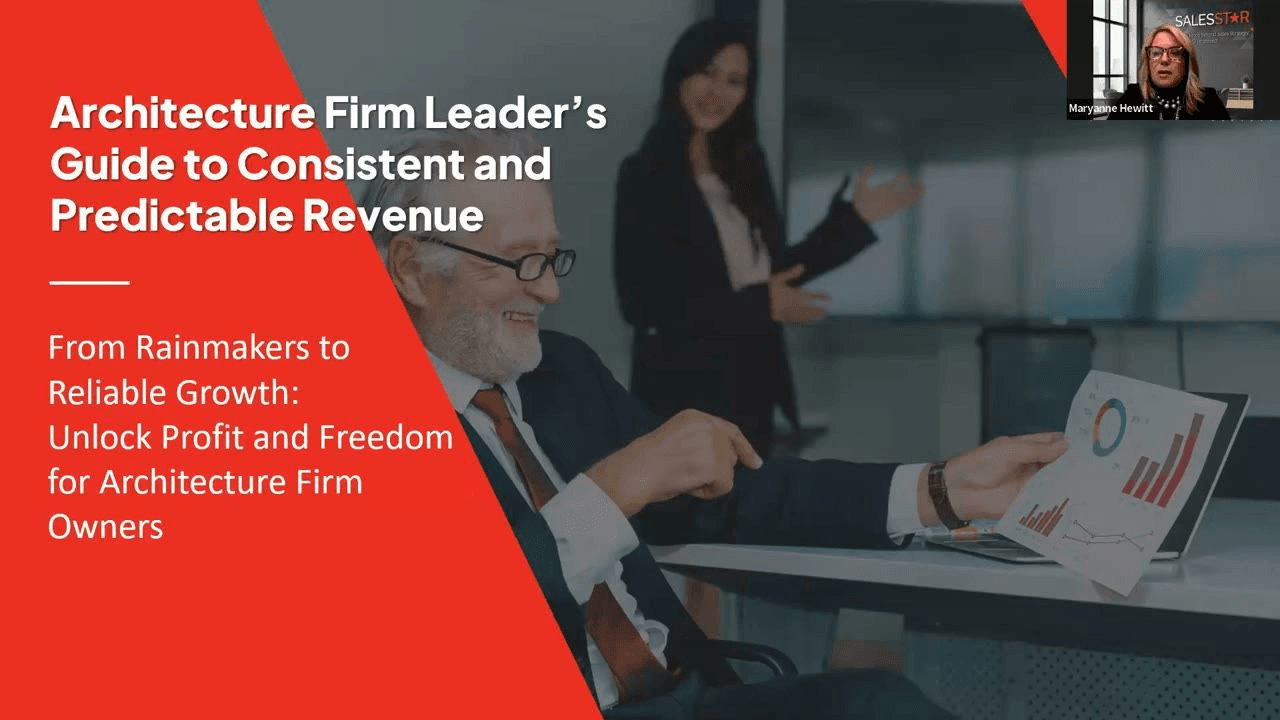
What's covered
Inside the session. Watch a clip, then get the full recording.
For many firms the future hinges on a handful of relationships held by one or two people, often the owner. The result is unpredictable revenue, sleepless nights and a firm that always feels one conversation away from a slowdown.
A pipeline full of every opportunity gives a false sense of security. Maryanne and Frank cover ideal client profiling, value-based selling, and the discipline to disqualify. Frank's general contractor client found its ideal client was one inexperienced in construction.
There is no shame in making a profit. Frank tells the story of a 35-year-old firm seven figures in debt because project teams consumed the entire fee on every job, and both discuss the cost of designing outside the client's scope.
Answering a live question on competitors who discount: run an effective discovery call before the proposal. Architects are not plumbers. Then measure your proposal-to-win ratio, especially on competitive pursuits.
The outcome of a high-performance sales system is freedom. A documented, milestone-centric process with KPIs, dashboards and pipeline reviews, starting with explore and discover phases well before the proposal.
A plan and process documented so they do not live in one person's head. Every business needs systems for operations, finance, people, and acquiring customers. Without all four, it is hard to scale.
Redefine success around profitability and predictability, not revenue alone. Then a repeatable process, an accurate pipeline that a forecast can rely on, and coaching with peer-to-peer accountability to build effectiveness.
Resources
Get the recording
Frequently asked questions
Common Questions
By documenting its business development plan and process so they do not live in one person's head. The session describes a systemised approach: a clear ideal client, a milestone-centric sales process, KPIs and dashboards, regular pipeline reviews, and coaching, so the rest of the team can take part in business development the way they take part in design.
Hold an effective discovery call before writing the proposal. Understand the client's objectives, challenges and pain points, then align your scope and fee to those outcomes. Maryanne's example: a client asks for three conference rooms, but may really need one room that splits three to five ways. Then you are a partner, not being measured cost for cost.
Well before the proposal. Frank compares starting at the proposal to starting a design process at CDs. He recommends two milestones first: explore, proactively seeking opportunities that fit your ideal client profile, and discover, engaging with them before you propose.
Proposals written versus projects won, at every step of the business development process. Frank adds that you should look specifically at competitive pursuits rather than work from existing clients, which inflates the number. The last 24 months of proposals gives a good baseline.
The session points to two habits: project teams using up the entire fee on every project rather than delivering under budget, and designing outside the scope of what the client asked for. Frank describes a firm 35 years in business that was seven figures in debt largely because of the first.
The next step
Stop running on heroics. Start engineering revenue.
Whichever way you work with us, the same proven Revenue OS runs underneath. Book a growth session and we’ll show you where to start.