
On-demand webinar
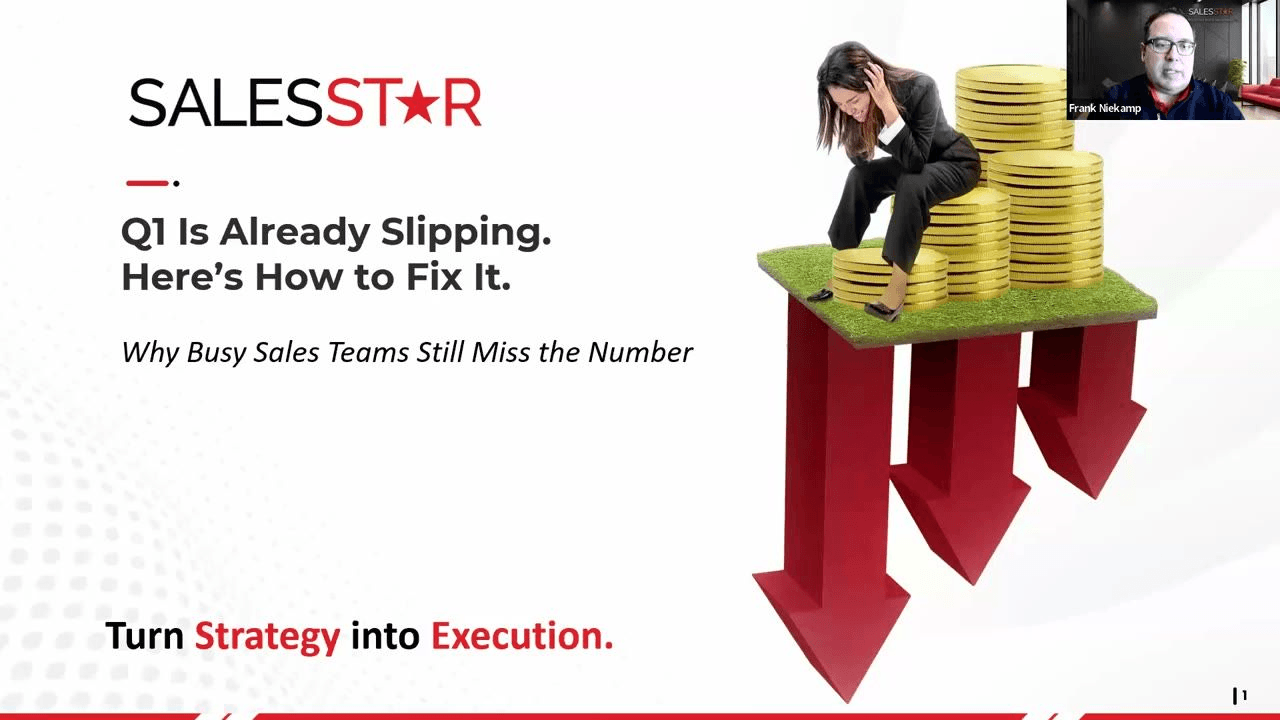
Why busy sales teams still miss the number
What you’ll learn :
- The four ways effort without structure shows up, from busy pipelines that do not convert to sales leaders who react instead of lead
- Second base selling: how a few discovery questions helped an equipment leasing company grow from $50 million to $65 million in twelve months
- Qualifying on evidence, not hope: go/no-go criteria for your ideal client and the DOUBTS discovery framework
- The weekly one-on-one agenda that keeps a sales leader's coaching centred on the sales process
Speaker :
Frank Niekamp
Chief Growth Officer · USA

David Mullins
Strategic Sales Coach · US
What's covered
Inside the session. Watch a clip, then get the full recording.
The year rarely fails suddenly; it shows its warning signs in Q1. Four ways effort without structure surfaces, and why research from McKinsey and Objective Management Group finds over 70% of sales leaders lack coaching and accountability skills.
A software company's pipeline-building campaign moved deals quickly to proposal, then they stalled for three months. In the live poll, roughly half of attendees were not confident they had a consistent standard for moving deals.
An equipment leasing company was jumping from the inbound call straight to the quote. Adding three or four minutes of discovery questions lifted order size and units, growing revenue from existing customers from $50 million to $65 million in twelve months.
Unreliable forecasts and pressure without clarity. A Houston company promoted its top rep to sales manager and revenue slipped, despite a laminated process nobody followed. Coaching through the pipeline took it from the mid-$20 millions to north of $40 million.
Four to six non-negotiables before a lead enters your nurture sequence, then the DOUBTS framework at discovery. A contractor spent $3 million on proposals and was zero for twenty on projects where it never met the decision makers.
Why the weekly one-on-one moves the needle more than anything after the foundations are built: CRM open, opportunities by milestone, agreed next steps. Group meetings are for motivation and coaching, not data dumps.
A robotics client's rep turns down a poor-fit deal and runs a real discovery conversation for the first time. Plus faster ramp-up for new hires, when salesperson turnover runs two to three times the all-employee average.
How long to give a promoted top performer who is not leading the way you need, what the first 30, 60 and 90 days should build, and whether to expect them to design the system alone.
Resources
Get the recording
Frequently asked questions
Common Questions
Because activity is not the same as advancing opportunities. Early-year wins are often carryover from last year, deals move to proposal without proper qualification, and sales leaders react to what reps are doing rather than coaching each deal through the stages of a defined sales process.
If an inbound enquiry is first base and the quote is third, second base is a short discovery step in between: a few focused questions about what the client is trying to achieve and what else they are working on. For one equipment leasing company it added three or four minutes per call and grew revenue from existing customers from $50 million to $65 million in twelve months.
Start with four to six non-negotiables drawn from your ideal client profile, a go/no-go list applied before a lead enters your nurture sequence. Then at discovery, check the decision-making process, others involved, budget and timetable; SalesStar uses its DOUBTS framework for this. One contractor spent $3 million on proposals in a year and won none of the twenty projects where it never met the decision makers.
Weekly as a general rule, or fortnightly if your sales cycle is long. Keep each to a tight agenda of around 30 to 45 minutes: open the CRM, review opportunities at each milestone, diagnose what is stuck, and agree priorities and next steps that the following meeting starts by checking.
Primarily motivation and coaching: a quick look at the numbers, perhaps a scorecard or leaderboard, and some training on a performance discipline. It is not the place to repeat what the CRM already shows, and a rousing movie-style speech is not what motivates salespeople. Helping them move opportunities so they can win is.
It depends on your situation. With most clients, the first 30, 60 and 90 days go into building foundations: process, leadership cadence and one-on-ones. Leading activity changes, such as more productive conversations and discovery meetings, usually show fairly quickly, while revenue depends on your sales cycle. Many capable leaders can execute a system well but lack the skills to design one alone.
The next step
Stop running on heroics. Start engineering revenue.
Whichever way you work with us, the same proven Revenue OS runs underneath. Book a growth session and we’ll show you where to start.