
On-demand webinar
By the time the RFP hits the street, it's too late
What you’ll learn :
- Why 80% of RFPs are already decided when they go out, and how to reach decision makers before the gag order
- How to find the 20% of clients driving 80% of your profit, and disqualify quickly when a client doesn't fit
- Why pricing on an average fee percentage of construction cost puts your firm at risk
- Where consultants can help you compete for bigger work, and why passing their fees through at cost loses money
Speaker :
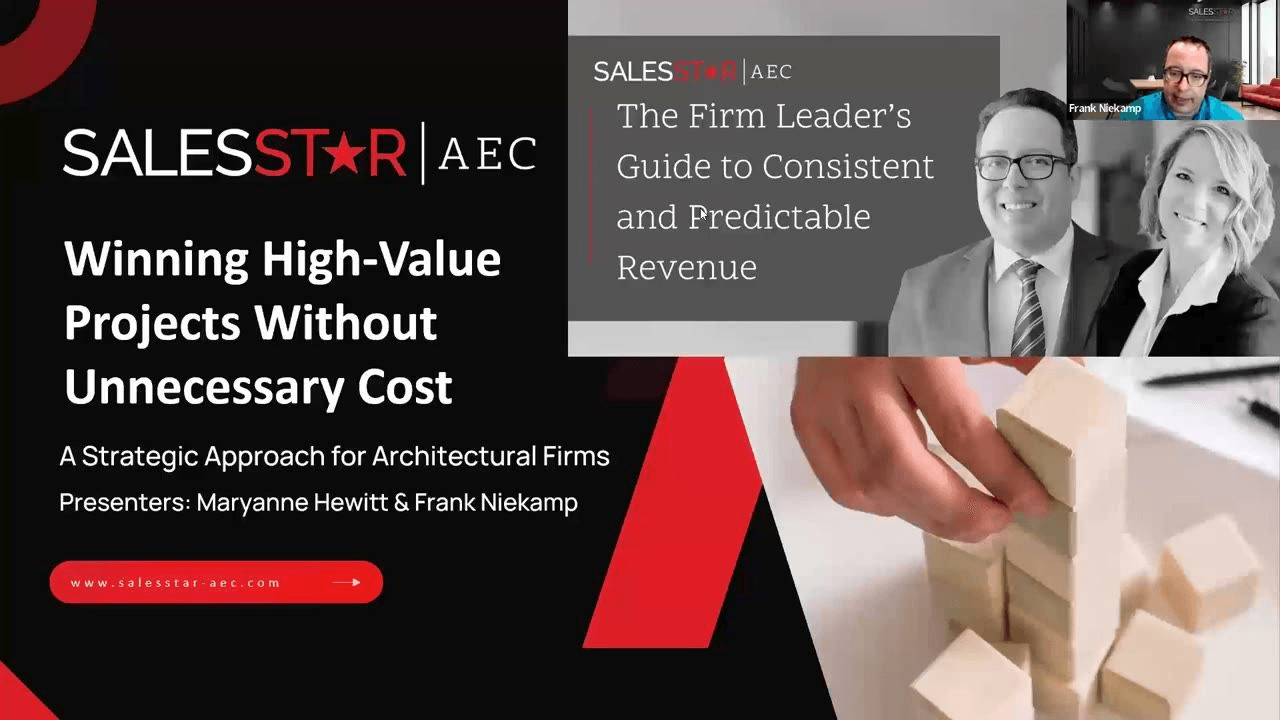
Frank Niekamp
Chief Growth Officer · USA

Maryanne Hewitt
High Performance Coach · AEC
What's covered
Inside the session. Watch a clip, then get the full recording.
High pursuit costs, low conversion rates, balancing growth with financial stability, and limited capacity. Low conversion rates led the audience poll, and Maryanne explains why so many RFP responses are a pencil-sharpening exercise.
Stop taking whatever work comes in to make payroll. Identify your ideal projects and the people connected to them, and use your own win and loss data to see what you win consistently and why.
Ask contractor friends who decides on current projects, because the same people tend to decide future ones. Ask for warm introductions, and ask for referrals right after you complete a great project.
Start smaller and build competence, look for portfolio experience that translates, or hire in the expertise. As Maryanne puts it, experience comes with you when you change firms.
Find the 20% of clients behind 80% of profit and build a profile around them. One firm stopped one-off restaurant work unless it came as a series, doubled from two to four million dollars and added only two people.
The AIA average fee is around four or five percent, but real fees range from two to eight or ten. Structure fees around the client's priorities, and tell stories the client can see themselves in, not just your awards.
Beyond MEP: civil, interior, graphic, acoustical and lighting design, and outsourced production as a bridge. The main pitfall is unclear communication, and with overhead around 25%, passing consultant fees through without a markup loses money.
Match your stories to the RFP, then stay in front of the client afterwards to help shape the next one. Before presenting design ideas, ask clarifying questions, because the priorities in the RFP have often changed.
Resources
Get the recording
Frequently asked questions
Common Questions
According to Maryanne, 80% of RFPs are already decided when they go out. Often an incumbent has helped craft the RFP with the client, and everyone else is there to keep the numbers honest. The firms in an advantaged position have been engaging the key decision makers before the RFP hits the street.
Frank asks contractor friends who the decision makers are on current projects, since the people deciding projects now and in the past are likely to decide future ones, and asks for warm introductions. Once the RFP is out, the issuer typically puts a gag order in place, so you have to reach them beforehand.
It depends on whether more follow. Frank sees firm owners take a small first project because the next nine can be very profitable once you know how the client works. One firm lost money on one-off restaurant projects, stopped taking them unless they came as a series, and doubled revenue from two to four million dollars while adding only two people.
As a guideline, yes. But the session points out that the average of around four or five percent for commercial work hides a range of two to eight or ten. Pricing on the average can leave you unable to deliver on a complex project or priced above competitors on a simple one. Structure fees around the client's priorities instead.
Yes. Passing them through at cost means you carry the liability and spend time coordinating without being paid for it. Maryanne puts typical firm overhead at around 25%, so if you are not charging somewhere close to 25% over the consultant's fee, you are losing money.
Make sure the stories and experience you present connect directly with the priorities in the RFP. Before presenting design ideas, ask clarifying questions, because those priorities are often inaccurate or have changed. Then stay in front of the client after the RFP so you can help shape the next one.
The next step
Stop running on heroics. Start engineering revenue.
Whichever way you work with us, the same proven Revenue OS runs underneath. Book a growth session and we’ll show you where to start.